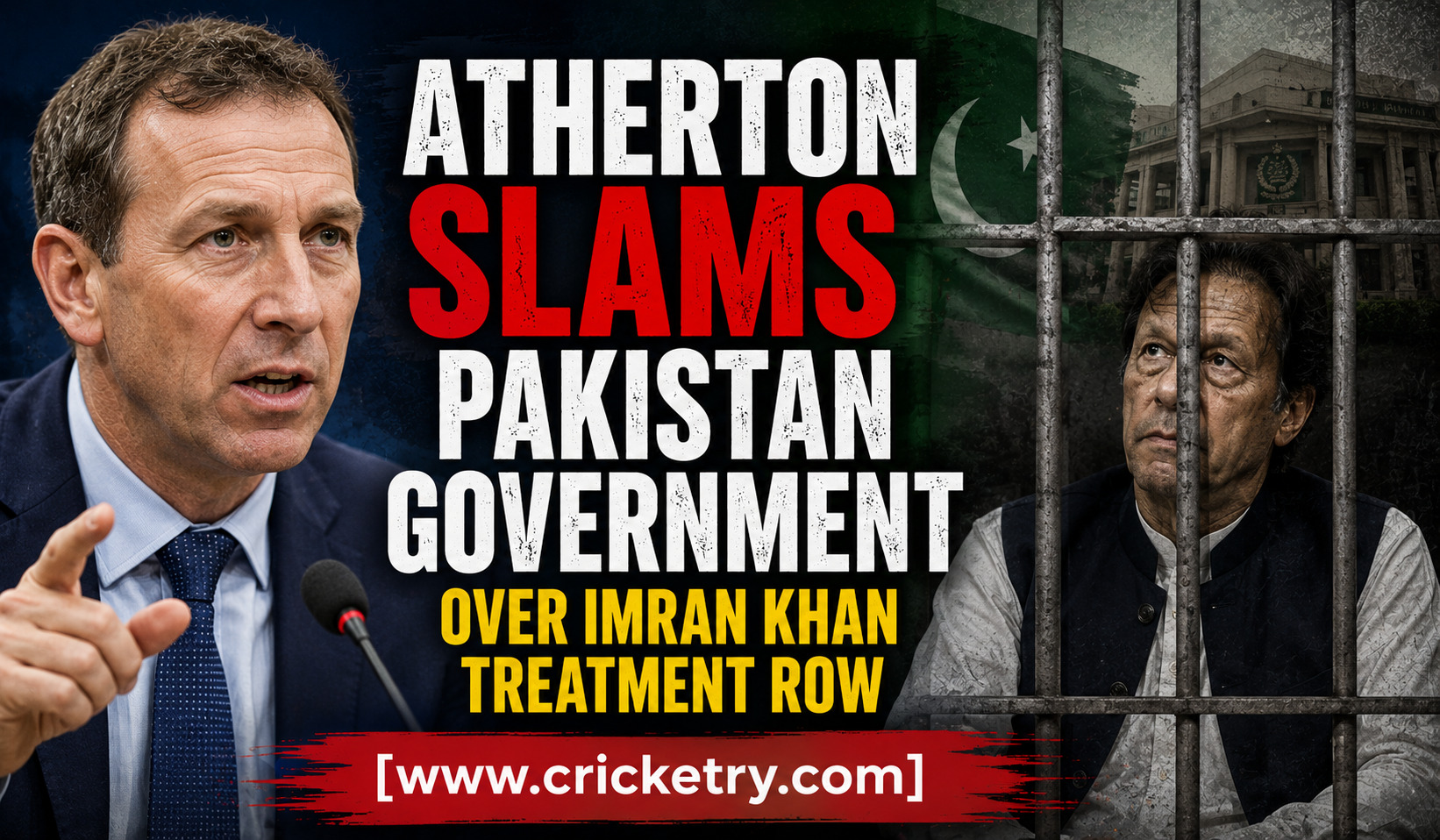
Former England captain Michael Atherton has criticised the Pakistan government over the treatment of jailed former Prime Minister and Pakistan cricket great Imran Khan, adding a fresh international voice to the growing controversy surrounding Khan’s health and medical care.
Atherton’s comments came after 21 former international cricket captains signed a renewed appeal to Pakistan Prime Minister Shehbaz Sharif, asking authorities to ensure that Khan receives appropriate medical treatment and that court-directed arrangements concerning his healthcare and family access are respected. The group included several of the biggest names in international cricket, including Sunil Gavaskar, Kapil Dev, Greg Chappell, Allan Border, Nasser Hussain and Stephen Waugh.
The controversy has intensified after a recent Supreme Court order concerning Khan’s medical examination. The court directed that Khan be transferred to Shifa International Hospital in Islamabad and examined by a medical board that would include his personal physician and sister, Dr Uzma Khan. Instead, authorities took him to the state-run Pakistan Institute of Medical Sciences (PIMS), citing security concerns, before returning him to Adiala Jail after a government-appointed medical team declared him medically fit.
For Atherton, the dispute is no longer simply about a former politician or a former cricketer. He believes it raises broader questions about how a high-profile prisoner should be treated and whether the medical process ordered by the country’s highest court was properly followed.
Atherton Questions the Treatment of Imran Khan
Speaking alongside fellow former England captain Nasser Hussain, Atherton said the international cricket community had become concerned about what was happening to Khan. He described the situation as an attempt by the state to “airbrush” Khan almost out of existence, highlighting the extraordinary nature of the criticism coming from a prominent figure in English cricket.
Atherton and Hussain were among the former international captains who signed the latest humanitarian appeal. The letter did not seek to intervene in Khan’s legal cases or challenge Pakistan’s judicial process. Instead, the former cricketers focused on his health, medical care and basic welfare while in custody.
That distinction is important. Khan remains a controversial political figure in Pakistan and has been imprisoned since 2023 following convictions in several cases. He has denied wrongdoing in cases he describes as politically motivated. The cricket captains’ appeal, however, was framed around his treatment as a prisoner rather than his political status.
The appeal therefore placed the spotlight on a humanitarian question: regardless of political disagreements or criminal convictions, should a former international sportsman and former head of government receive the medical care ordered by a court?
Why Imran Khan’s Medical Treatment Has Become a Major Issue
Concern over Khan’s health has been building for months. His family and Pakistan Tehreek-e-Insaf (PTI) have repeatedly raised concerns about his medical condition, particularly problems involving his right eye. Earlier reports also said Khan had undergone treatment for an eye-related condition.
The Pakistani government has strongly disputed claims that Khan has been denied adequate medical care or subjected to deliberate mistreatment. Officials have argued that he has received medical examinations and that security considerations influenced decisions about where he could be treated. According to an Associated Press report, the government said Khan had undergone around 30 medical examinations and rejected allegations of medical neglect and solitary confinement.
This disagreement has created two sharply different narratives. Khan’s family and political supporters argue that authorities have not provided the independent medical assessment ordered by the Supreme Court. Government representatives, meanwhile, maintain that the former prime minister is receiving necessary healthcare and that his status as a convicted prisoner does not justify special treatment.
The latest cricket captains’ intervention has given the issue additional international attention.
Supreme Court Order at the Centre of the Dispute
The immediate controversy stems from a Supreme Court decision issued on August 18. According to Pakistani newspaper Dawn, the court directed that Khan be shifted to Shifa International Hospital in Islamabad and that a medical board be formed, including his sister and personal physician.
The subsequent decision to take Khan to PIMS rather than the hospital named in the order became a major point of contention.
Authorities cited security concerns for the change. PTI and Khan’s family argued that the government had failed to comply with the court’s instructions. Khan’s party subsequently sought contempt proceedings against government officials, alleging that the court order had not been implemented as required. Reuters reported that PTI sought action against senior officials over the hospital transfer.
The government has rejected the accusations and argued that Khan’s treatment should be governed by the same rules that apply to prisoners generally.
This legal disagreement has turned what began as a medical issue into a wider confrontation involving the judiciary, government, opposition politics and Khan’s supporters.
Former Cricket Captains Unite Behind Khan
The involvement of former international captains is particularly significant because Imran Khan’s cricket legacy remains central to his public identity.
Khan led Pakistan to their first and only ODI World Cup title in 1992. His career as an all-rounder and captain made him one of the most recognised figures in Pakistan cricket long before he entered politics.
The latest appeal brought together former opponents and teammates from different cricketing nations. The signatories included legendary figures from India, England, Australia, the West Indies, New Zealand and other cricket-playing countries.
The central message was that the appeal should not be interpreted as political intervention.
The former captains asked Pakistani authorities to complete the court-directed independent medical assessment and provide whatever treatment is recommended. They also urged authorities to honour the family-visit arrangements restored by the Supreme Court.
The key requests can be summarised as follows:
- Complete an independent medical assessment involving Khan’s own doctors.
- Provide medically recommended treatment without unnecessary delay.
- Respect the court-directed arrangements concerning family visits.
- Ensure that Khan receives humane treatment regardless of his political status.
The appeal has attracted attention because many of the signatories once competed against Khan on the cricket field. Their intervention illustrates the lasting respect he commands within parts of the international cricket community.
Kapil Dev Separates Cricketing Concerns From Politics
Former India captain Kapil Dev also supported the appeal and emphasised that the cricketers were not asking Pakistan to interfere with Khan’s legal proceedings.
Kapil said the request was fundamentally about humanity and medical care. His position reflected the broader argument made by the former captains: legal proceedings and prison conditions are separate questions.
That distinction has helped the former players frame their intervention as a humanitarian appeal rather than an endorsement of Khan’s political position.
The issue is particularly sensitive because relations between India and Pakistan remain complicated, while Khan himself is a former political leader who continues to command substantial support among Pakistanis. The participation of Indian cricket legends such as Kapil Dev and Sunil Gavaskar therefore adds another layer of significance to the appeal.
Pakistan Government Rejects Allegations
Pakistan’s government has rejected allegations that Khan is being deliberately mistreated.
Officials have said that Khan is a convicted prisoner and that authorities have continued to provide him with medical care. The government has also rejected claims that he is being held in solitary confinement and has pointed to the number of visits and medical examinations he has received since his imprisonment.
Security has also become a central argument. Authorities have maintained that moving a high-profile prisoner to a private hospital presents significant security challenges. This was cited as the reason for taking Khan to PIMS instead of following the requested transfer to Shifa International Hospital.
The government has therefore presented the dispute as a question of practical security and prison administration rather than deliberate denial of healthcare.
However, Khan’s family and PTI continue to challenge that explanation.
What Makes Atherton’s Comments Significant?
Atherton is not a political activist or Pakistani opposition figure. He is a former England captain and one of the most respected voices in contemporary cricket journalism.
His involvement therefore gives the controversy a different dimension. Atherton’s criticism is based largely on the humanitarian concerns raised by the former captains and on the circumstances surrounding Khan’s medical care.
For Pakistan cricket followers, the comments also carry emotional significance because Khan remains one of the country’s greatest sporting figures. His 1992 World Cup victory is still regarded as one of the defining moments in Pakistan cricket history.
The fact that former captains from several generations have come together over his treatment demonstrates how strongly Khan’s sporting legacy continues to resonate internationally.
The Political Background Cannot Be Ignored
Although the cricket captains have attempted to keep their appeal focused on humanitarian issues, the controversy exists within a highly charged political environment.
Khan was removed as Pakistan’s prime minister in 2022 and was subsequently arrested in 2023. He has remained in prison while facing multiple legal cases. Khan and his supporters have repeatedly argued that the cases against him are politically motivated, while Pakistani authorities reject those claims.
His imprisonment has repeatedly triggered political tensions and protests. Consequently, any development involving Khan’s health or prison conditions can quickly become a national political issue.
That is why the former cricketers have stressed that they are not seeking special political treatment. Their appeal is centred on medical care, family access and the implementation of judicial directions.
What Happens Next?
The immediate focus will be on whether the Pakistani authorities and the courts can resolve the dispute over Khan’s medical treatment.
The former cricket captains have made clear that they want the court-directed medical process completed and any treatment recommended by the medical board to be provided. Meanwhile, Khan’s political party has already taken legal steps over the government’s handling of the hospital transfer.
The government, for its part, continues to argue that Khan’s healthcare is being managed appropriately and that security considerations cannot be ignored.
The situation therefore remains closely linked to both medical and legal developments.
Why This Story Matters Beyond Cricket
The controversy has moved well beyond the boundaries of sport. Imran Khan’s cricket career made him a global sporting personality, but his later political career transformed him into one of Pakistan’s most influential and divisive political figures.
Atherton’s intervention demonstrates how sporting relationships can continue long after players leave the field. Former opponents who once competed against Khan are now speaking about his welfare because they believe the issue has crossed into humanitarian territory.
At the same time, the dispute highlights the difficult balance governments face when dealing with high-profile prisoners. Security, equal treatment, medical independence and judicial authority all come into play.
For now, the central question remains straightforward: will the authorities ensure that the medical process ordered by the Supreme Court is fully carried out?
Conclusion
Michael Atherton’s criticism has added significant international attention to the growing dispute over Imran Khan’s treatment in Pakistani custody. His comments came as a group of former international cricket captains renewed their appeal for proper medical care and humane treatment for the former Pakistan captain and prime minister.
The dispute centres on Khan’s medical condition, an alleged loss of vision in his right eye, the Supreme Court’s instructions regarding his examination and the government’s decision to take him to a state hospital rather than the private facility named in the order. Khan’s family and PTI say the authorities have failed to follow the court’s directions, while the government says security concerns justified its actions and denies allegations of medical neglect.
Atherton and the other former captains have deliberately framed their intervention as a humanitarian matter rather than a political endorsement. Their message is that whatever the outcome of Khan’s legal and political battles, his basic welfare and access to appropriate medical care should not be compromised.
As the legal dispute continues, the cricket world will be watching closely. For many former players, the issue is no longer about Pakistan’s political divisions but about ensuring that one of the game’s most recognisable former captains receives the treatment and dignity they believe every prisoner deserves.
Frequently Asked Questions
Who is Michael Atherton?
Michael Atherton is a former England Test captain and an established cricket commentator and journalist. He played international cricket for England and later became a prominent cricket writer and broadcaster.
What did Atherton say about Imran Khan?
Atherton criticised the Pakistani state’s handling of Khan’s situation and described what he viewed as an attempt to “airbrush” Khan almost out of existence. His comments came after he joined other former international captains in an appeal concerning Khan’s medical care.
Why are former cricket captains supporting Imran Khan?
The former captains say their intervention is humanitarian rather than political. They are calling for proper medical treatment, an independent medical assessment and respect for court-directed arrangements concerning Khan’s welfare.
What happened during Imran Khan’s recent hospital transfer?
Following a Supreme Court order, Khan was taken for medical examination, but authorities transferred him to the state-run PIMS facility rather than the private hospital specified in the court order. He was returned to prison after being declared medically fit by a government-appointed medical team.
What does the Pakistan government say?
The government denies allegations of medical neglect and mistreatment. Officials say Khan has received medical examinations and care and have cited security concerns regarding his hospital transfer.
About the Author