
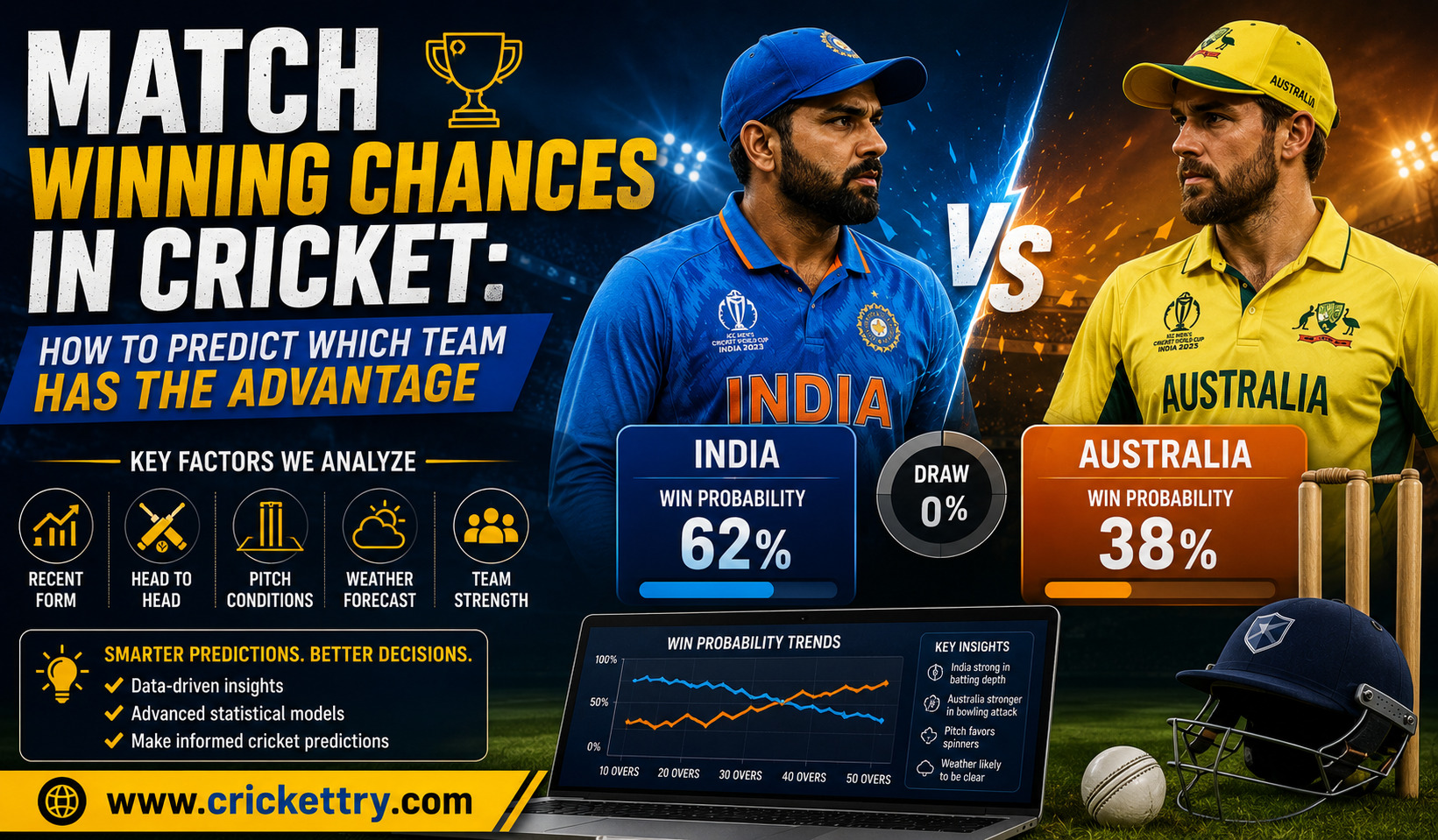

Cricket is a game full of excitement, surprises, and unforgettable moments. A team that looks unbeatable in the first half of a match can suddenly find itself under pressure. This is what makes cricket different from many other sports. While fans always support their favourite teams, they also love to know one thing before and during a match: which team has the better chance of winning?
Match winning chances help fans understand the current situation of a game. These chances are based on many factors such as team strength, player performance, pitch conditions, weather, and past records. However, cricket is unpredictable, and even the strongest team can lose on a special day.
In this article, we will understand how match winning chances are decided and what factors can influence the result of a cricket match.
What Are Match Winning Chances?
Match winning chances show the possibility of a team winning a cricket match. They are usually shown in percentage form.
For example:
- India – 65% chance of winning
- Australia – 35% chance of winning
This means India appears to have an advantage based on available information. It does not guarantee victory because cricket can change quickly with one good over, one brilliant catch, or one great batting performance.
Winning chances are simply a way to understand which team currently has more control over the match.
Factors That Decide Match Winning Chances
Many things affect the chances of a team winning. Let us look at the most important factors.
1. Current Team Form
A team’s recent performance plays an important role in predicting match results.
A team that has won several matches recently usually enters the game with confidence. Players are in good rhythm, and the team understands how to handle pressure situations.
For example:
- A team with strong batting performances in recent games may have an advantage.
- A team with successful bowlers may perform better on difficult pitches.
However, past success does not always guarantee future results. Every match brings a new challenge.
2. Player Performance
Individual players can completely change the direction of a match.
A batsman who is scoring runs regularly can increase his team’s chances. Similarly, a bowler who is taking wickets consistently can create problems for the opposition.
Important player factors include:
- Recent batting form
- Bowling performance
- Fitness level
- Experience in pressure situations
- Performance against a particular opponent
For example, a team with experienced players who have performed well in big matches may have an advantage in important games.
3. Playing XI Selection
The final team selection can greatly impact winning chances.
A team with its best players available usually has a stronger chance of winning. Injuries, player rotation, or unexpected changes can affect team balance.
Important questions include:
- Are the main batsmen playing?
- Are the key bowlers available?
- Does the team have enough all-rounders?
- Is the combination suitable for the pitch?
A well-balanced playing XI often performs better than a team that depends only on a few players.
4. Pitch Conditions
The pitch is one of the biggest factors in cricket.
Different pitches support different styles of play.
A batting-friendly pitch helps batsmen score more runs. A pitch that helps bowlers can make batting difficult.
For example:
- A flat pitch may increase the chances of a high-scoring match.
- A pitch with movement may help fast bowlers.
- A turning pitch may help spin bowlers.
Teams that understand the pitch conditions often have an advantage.
5. Weather Conditions
Weather can influence cricket matches in many ways.
Rain can reduce the number of overs, change team strategies, or even stop the match completely.
Other weather factors include:
- Temperature
- Humidity
- Wind conditions
- Cloud cover
Some bowlers perform better in certain weather conditions, while some batsmen prefer specific environments.
6. Head-to-Head Record
The previous matches between two teams can provide useful information.
Some teams perform better against certain opponents because they understand their strengths and weaknesses.
For example:
- Team A may have won most recent matches against Team B.
- A particular batsman may have a strong record against a certain bowling attack.
However, old records should not be the only reason to predict a winner. Current form is usually more important.
7. Home Advantage
Playing at home often gives teams extra confidence.
Home teams usually understand:
- Local pitch conditions
- Weather patterns
- Ground size
- Crowd support
Many teams perform better in their own country because they are familiar with the conditions.
However, strong teams can also win away matches through better preparation and planning.
8. Pressure Handling Ability
Cricket matches are often decided by how players handle pressure.
A team may have talented players, but staying calm during important moments is equally important.
Pressure situations include:
- Chasing a big target
- Defending a small total
- Playing in a final
- Facing a strong opponent
Experienced players often help teams perform better in difficult situations.
9. Team Strategy
A good strategy can increase a team’s chances of winning.
Captains make important decisions during matches, such as:
- Choosing bowlers at the right time
- Changing batting order
- Setting field placements
- Deciding when to attack or defend
A smart captain can change the result of a match through better decisions.
10. Toss Result
The toss may look like a small factor, but it can sometimes influence the game.
The winning team may choose to bat or bowl depending on conditions.
For example:
- A team may prefer batting first on a dry pitch.
- A team may choose bowling first if there is early help for bowlers.
The toss does not decide the winner, but it can provide an advantage.
How Experts Predict Match Winning Chances
Cricket experts use different information before predicting match results.
They study:
- Recent team performances
- Player statistics
- Ground history
- Pitch reports
- Weather conditions
- Team combinations
- Previous meetings
They combine all these details to understand which team looks stronger.
However, experts also know that cricket has many unexpected moments. A single player’s performance can change everything.
Match Winning Chances During Live Matches
Winning chances keep changing during a match.
A team that starts as a favourite may lose its advantage after losing quick wickets.
For example:
Before the match:
India – 60% chance
Australia – 40% chance
After India loses early wickets:
India – 35% chance
Australia – 65% chance
Live situations affect predictions.
Important moments that change winning chances include:
- Quick wickets
- Big partnerships
- Fast scoring
- Bowling spells
- Dropped catches
- Rain interruptions
Role of Statistics in Match Predictions
Numbers help fans understand team performance.
Some useful statistics include:
- Average runs scored
- Number of wickets taken
- Win percentage
- Player records
- Recent match results
Statistics provide useful information, but they cannot predict every result.
Cricket is played by humans, and emotions, confidence, and pressure also matter.
Why Cricket Predictions Can Be Wrong
Even accurate predictions can fail because cricket is unpredictable.
Some reasons include:
Unexpected Player Performance
A new player can produce a match-winning performance.
Brilliant Individual Effort
A single century or five-wicket performance can completely change a match.
Mistakes Under Pressure
Dropped catches, poor shots, or bowling mistakes can affect results.
Changing Conditions
Weather or pitch behaviour can change during the match.
This uncertainty is what makes cricket exciting.
Match Winning Chances in Different Formats
Winning chances can differ depending on the format.
Test Matches
Test cricket requires patience and consistency. Teams need to perform well over several days.
Factors that matter:
- Strong batting depth
- Quality bowling attack
- Ability to handle different conditions
One Day Internationals (ODIs)
ODIs require a balance between attack and control.
Important factors include:
- Building partnerships
- Managing runs
- Taking wickets regularly
T20 Matches
T20 cricket changes quickly.
Important factors include:
- Fast scoring
- Power hitting
- Effective bowling in short periods
- Handling pressure
A single over can change the entire match.
How Fans Can Understand Match Chances Better
Fans can improve their understanding by following:
- Team news before matches
- Player form
- Pitch reports
- Previous performances
- Playing XI announcements
Instead of looking at only one factor, consider the complete picture.
Final Thoughts
Match winning chances are a helpful way to understand which team has an advantage before and during a cricket match. They are based on many factors including player form, team strength, pitch conditions, weather, strategy, and previous records.
However, cricket is not decided only by numbers. The beauty of the game comes from unexpected moments. A player can create history with one great innings or a memorable bowling spell.
The best approach is to use winning chances as a guide, not as a guarantee. A strong team may have better chances, but cricket always gives every team an opportunity to fight back.
Whether it is an international match, IPL game, or a local tournament, the excitement comes from one simple fact — anything can happen until the final ball is bowled.