
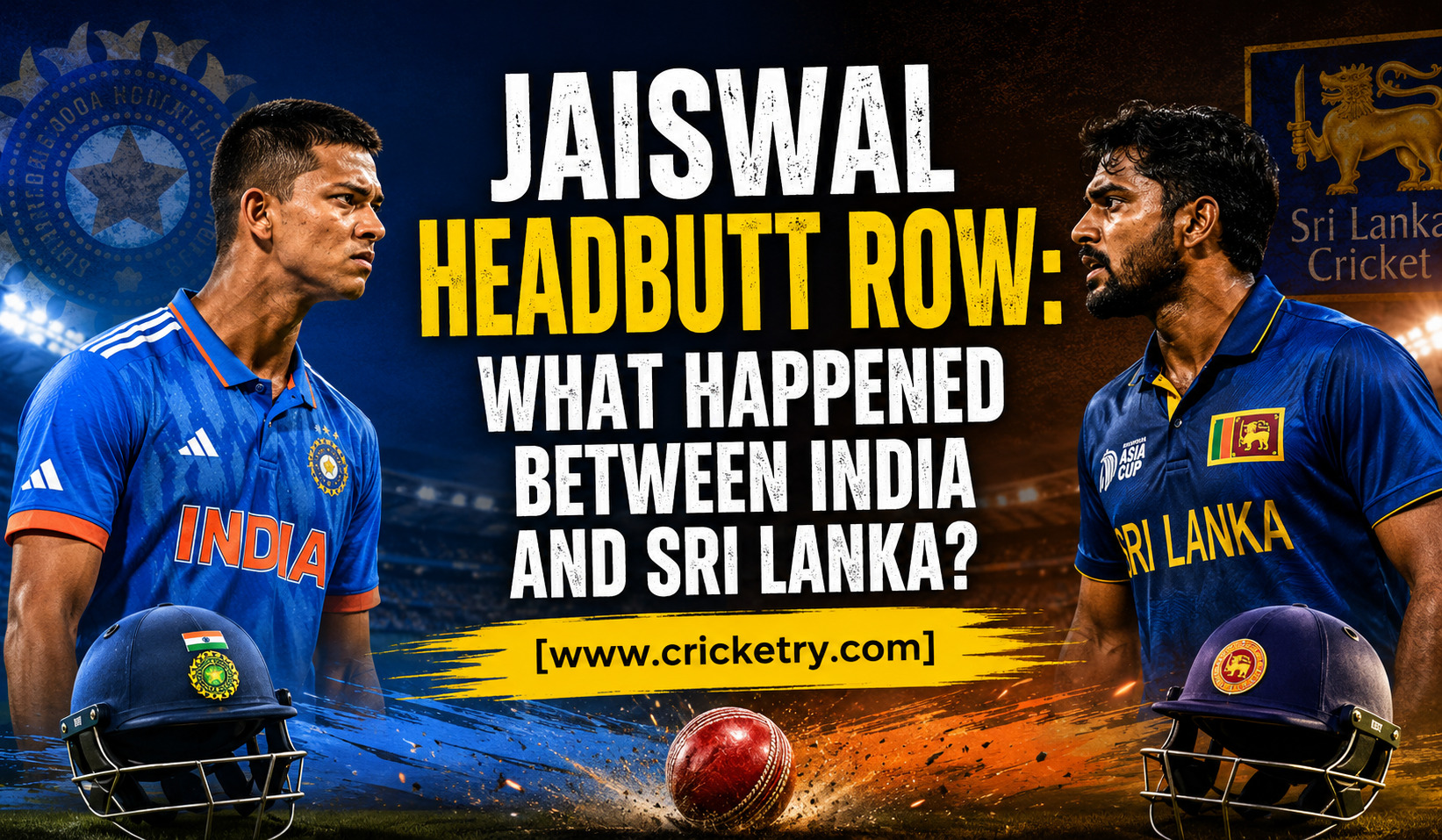

The second Test between India and Sri Lanka in Colombo produced a tense moment that quickly became one of the biggest talking points of the series. India opener Yashasvi Jaiswal and Sri Lanka fast bowler Asitha Fernando were involved in a heated confrontation after Jaiswal was dismissed on the opening day, with television footage appearing to show the two players making head-to-head contact.
What initially looked like a brief on-field argument soon developed into a disciplinary issue. The International Cricket Council (ICC) later sanctioned both players for breaching its Code of Conduct, with each receiving a 25 percent fine from their match fee and one demerit point.
The incident attracted considerable attention because physical confrontation between players is treated differently from ordinary verbal exchanges in cricket. It also raised questions about Jaiswal’s temperament, Fernando’s role in the exchange and whether the punishment handed down by the ICC was sufficient.
Importantly, both players admitted the offence and accepted the sanctions, meaning there was no need for a formal hearing. The ICC classified the incident as a Level 1 breach under Article 2.12, which deals with inappropriate physical contact involving players or officials.
How Did the Jaiswal-Fernando Incident Begin?
The confrontation happened during the first day of the second Test in Colombo. Jaiswal had been attempting to establish himself at the crease when Fernando eventually dismissed him.
Rather than ending quietly with the fall of the wicket, the moment turned into an exchange between the batter and bowler. After Jaiswal’s dismissal, the two players moved towards each other and exchanged words. The situation escalated when their heads appeared to make contact.
Players from both teams quickly intervened to prevent the confrontation from becoming more serious. Sri Lankan captain Dhananjaya de Silva was also involved in calming the situation.
The incident was replayed repeatedly on television and circulated widely online. The visual of two international cricketers appearing to make physical contact immediately attracted criticism because such behaviour is considered beyond the normal competitive exchanges seen in Test cricket.
The key sequence can be understood simply:
- Fernando dismissed Jaiswal.
- A verbal exchange followed the dismissal.
- Jaiswal and Fernando moved towards each other.
- Their heads appeared to make contact before teammates intervened.
The exact words exchanged between the two players have not been fully established publicly, which is important when assessing who initiated the confrontation or what triggered it.
What Did Jaiswal Say About the Incident?
Jaiswal later responded to the criticism surrounding the confrontation. The India opener indicated that there had been provocation during the exchange and suggested that people watching the footage did not necessarily know what had been said between the players.
His response added another layer to the story because some former cricketers had already criticised his decision to get physically close to Fernando.
Jaiswal also used social media to defend his competitive attitude, with his comments about India fighting and responding strongly becoming part of the wider discussion around the incident.
However, defending the emotional context does not remove the disciplinary issue. Cricket allows players to show aggression and engage in intense verbal competition, but there are boundaries around physical contact.
That distinction has been central to the debate. Many observers have argued that Jaiswal can maintain his aggressive approach without allowing an argument to become physical.
Why Was Jaiswal Punished by the ICC?
The ICC Code of Conduct specifically addresses inappropriate physical contact between players. In this case, both Jaiswal and Fernando were found to have breached Article 2.12.
The ICC imposed the same punishment on both players: a 25 percent deduction from their match fees and one demerit point each. Both admitted their respective breaches and accepted the proposed sanctions.
The fact that both players received the same financial penalty is significant. It indicates that the ICC treated the confrontation as a shared disciplinary incident rather than placing the entire responsibility on one individual.
Their previous disciplinary records also played a role in the outcome. Reports noted that neither player had a disciplinary offence recorded against them during the previous 24 months, which meant the Level 1 sanctions did not lead to a suspension.
Jaiswal-Fernando Punishment at a Glance
| Player | Offence | ICC Action | Demerit Points |
| Yashasvi Jaiswal | Article 2.12 breach | 25% match-fee fine | 1 |
| Asitha Fernando | Article 2.12 breach | 25% match-fee fine | 1 |
The punishment therefore ended the immediate disciplinary uncertainty surrounding the incident.
Was Jaiswal’s Action Considered a Headbutt?
The term “headbutt” has been widely used in headlines and social media discussions because footage appeared to show Jaiswal making contact with Fernando’s head.
However, describing the event as a deliberate headbutt can go beyond what has officially been established. The ICC’s disciplinary decision was based on inappropriate physical contact rather than a public finding that Jaiswal intentionally attempted to injure Fernando.
That distinction matters.
A heated confrontation can escalate quickly, and television footage may not provide the complete context of what happened immediately before physical contact. The safest description is therefore that the two players were involved in a confrontation that included head-to-head physical contact.
The ICC’s decision confirms that the contact breached the Code of Conduct, but it does not necessarily establish every detail of the argument or the intentions of either player.
Why Did the Incident Attract So Much Criticism?
Cricket has a long tradition of competitive sledging and verbal exchanges. Players regularly attempt to unsettle opponents, particularly in Test cricket, where matches can last several days and psychological battles form an important part of the contest.
Physical contact is different.
That is why former cricketers and commentators reacted strongly. Cheteshwar Pujara described the visual as “not an ideal visual” and questioned whether Jaiswal needed to move towards Fernando after the dismissal.
Other former players also criticised Jaiswal and warned that aggressive behaviour can have consequences if it crosses the line.
The criticism was not necessarily directed at Jaiswal’s competitive personality itself. Instead, the discussion centred on the need for an international player to maintain control even when emotions are high.
That is particularly relevant for Jaiswal because he has developed a reputation for playing with enormous intensity. His aggression is often considered one of his strengths as a batter, but managing that emotion is equally important at international level.
India’s Perspective on the Incident
India’s support staff also acknowledged that Jaiswal should have handled the situation differently.
India batting coach Sitanshu Kotak indicated that Jaiswal should not have moved so close to Fernando during the confrontation. At the same time, he suggested that the circumstances surrounding the exchange should also be considered.
That position reflects the complexity of the incident. Cricket is an emotional sport, and players can become frustrated after dismissals or heated exchanges. But international players are expected to know where the boundary lies.
For India, the incident was an unwanted distraction during a Test series in which the team’s performances were already attracting attention. Jaiswal is a key part of India’s batting plans, making his discipline and availability important beyond the immediate controversy.
The one-match-fine outcome meant India did not lose Jaiswal to a suspension, allowing the issue to remain primarily a disciplinary matter rather than becoming a major selection problem.
Did Sri Lanka Also Face Consequences?
Yes. Fernando was punished alongside Jaiswal.
This is an important part of the story because some of the initial online discussion focused almost entirely on Jaiswal. The ICC’s final decision made clear that both players had breached Article 2.12.
Fernando’s involvement in the confrontation therefore carried its own disciplinary consequence. He received the same 25 percent match-fee fine and one demerit point.
The equal punishment suggests that the ICC considered the physical confrontation a matter involving both players rather than treating one side as solely responsible.
That decision may also help bring the immediate controversy to a close, allowing the teams to concentrate on the cricket rather than continuing the dispute away from the field.
The Bigger Debate: Aggression vs Sportsmanship
The Jaiswal-Fernando incident has revived an old debate in international cricket: how much aggression should be accepted from players?
Competitive intensity is an essential part of Test cricket. Fast bowlers celebrate wickets loudly, batters respond to sledging and players frequently challenge opponents verbally. These moments can make the game more compelling.
But there is a difference between controlled aggression and losing control.
For modern international cricketers, that distinction is becoming increasingly important. Cameras cover almost every moment, social media can spread incidents worldwide within minutes and disciplinary rules are closely monitored.
The debate surrounding Jaiswal is therefore not simply about one incident. It is about how young stars manage the pressure and attention that comes with international cricket.
Jaiswal has already established himself as one of India’s most important young batters. His next stage of development will involve not only improving his batting but also learning how to channel his competitive energy effectively.
Could the Incident Have Led to a Bigger Punishment?
Before the ICC decision was announced, there was considerable speculation about whether Jaiswal could face a suspension. Because physical contact is specifically covered by the Code of Conduct, some reports discussed the possibility of a more serious sanction.
The eventual Level 1 punishment was much lighter.
Several factors helped explain the outcome, including the classification of the offence, the players’ acceptance of responsibility and their clean disciplinary records over the previous 24 months.
The final decision therefore demonstrated that not every physical confrontation automatically results in a match ban. The ICC considers the nature of the breach and the player’s disciplinary history when determining the appropriate punishment.
What Does This Mean for Jaiswal Going Forward?
The immediate consequences for Jaiswal are limited to the fine and demerit point, but the incident could still become a learning experience.
At 24, Jaiswal is still developing as an international cricketer. His attacking batting style has already made him a major part of India’s future, and his ability to maintain intensity without crossing disciplinary boundaries will be important.
The incident should not define his career. However, it does provide a reminder that emotions can become costly when they move from verbal exchanges into physical confrontation.
For Jaiswal, the most effective response will ultimately come through his cricket. Maintaining his aggressive approach while showing greater composure could allow him to retain one of his biggest strengths without creating unnecessary disciplinary problems.
India vs Sri Lanka: The Incident in Context
| Aspect | Details |
| Match | India vs Sri Lanka, second Test |
| Venue | Colombo |
| Players involved | Yashasvi Jaiswal and Asitha Fernando |
| Stage | First day of the Test |
| Trigger | Jaiswal’s dismissal by Fernando |
| Main issue | Heated confrontation and physical contact |
| ICC charge | Article 2.12 |
| Jaiswal’s punishment | 25% match-fee fine + 1 demerit point |
| Fernando’s punishment | 25% match-fee fine + 1 demerit point |
| Hearing | Not required after both players admitted the breach |
Conclusion
The Jaiswal headbutt row began with a routine part of Test cricket—a bowler dismissing a batter—but quickly escalated into an incident that attracted global attention.
Yashasvi Jaiswal and Asitha Fernando exchanged words after the dismissal before appearing to make head-to-head physical contact. Teammates intervened, and the matter was subsequently reviewed under the ICC Code of Conduct.
The ICC ultimately found both players guilty of a Level 1 breach of Article 2.12. Each was fined 25 percent of his match fee and received one demerit point. Both players admitted the offence, meaning no formal hearing was required.
The incident has also prompted a wider conversation about aggression in modern cricket. Jaiswal’s competitive attitude is a major part of his identity as a player, but the controversy shows why international cricketers must maintain control when emotions rise.
For India, the best outcome is to move forward without allowing the incident to overshadow the team’s cricket. For Jaiswal, it is an opportunity to learn from the episode while continuing to play with the intensity that has made him one of India’s most exciting young batters.
Ultimately, the Colombo confrontation will be remembered less for the argument itself than for the question it raises: how can players bring passion and aggression to international cricket without crossing the line into unacceptable behaviour?
FAQs
What happened between Yashasvi Jaiswal and Asitha Fernando?
The confrontation occurred after Fernando dismissed Jaiswal during the first day of the second Test in Colombo. The two exchanged words and subsequently made physical contact, with footage appearing to show their heads coming together.
Why was Yashasvi Jaiswal punished?
Jaiswal was punished for breaching Article 2.12 of the ICC Code of Conduct, which covers inappropriate physical contact involving players or officials.
What punishment did Jaiswal receive?
The ICC fined Jaiswal 25 percent of his match fee and awarded him one demerit point.
Was Asitha Fernando also punished?
Yes. Fernando received the same punishment as Jaiswal: a 25 percent match-fee fine and one demerit point.
Did Jaiswal receive a match ban?
No. The ICC imposed a Level 1 sanction, and Jaiswal was not suspended. His clean disciplinary record over the previous 24 months was among the factors relevant to the outcome.