
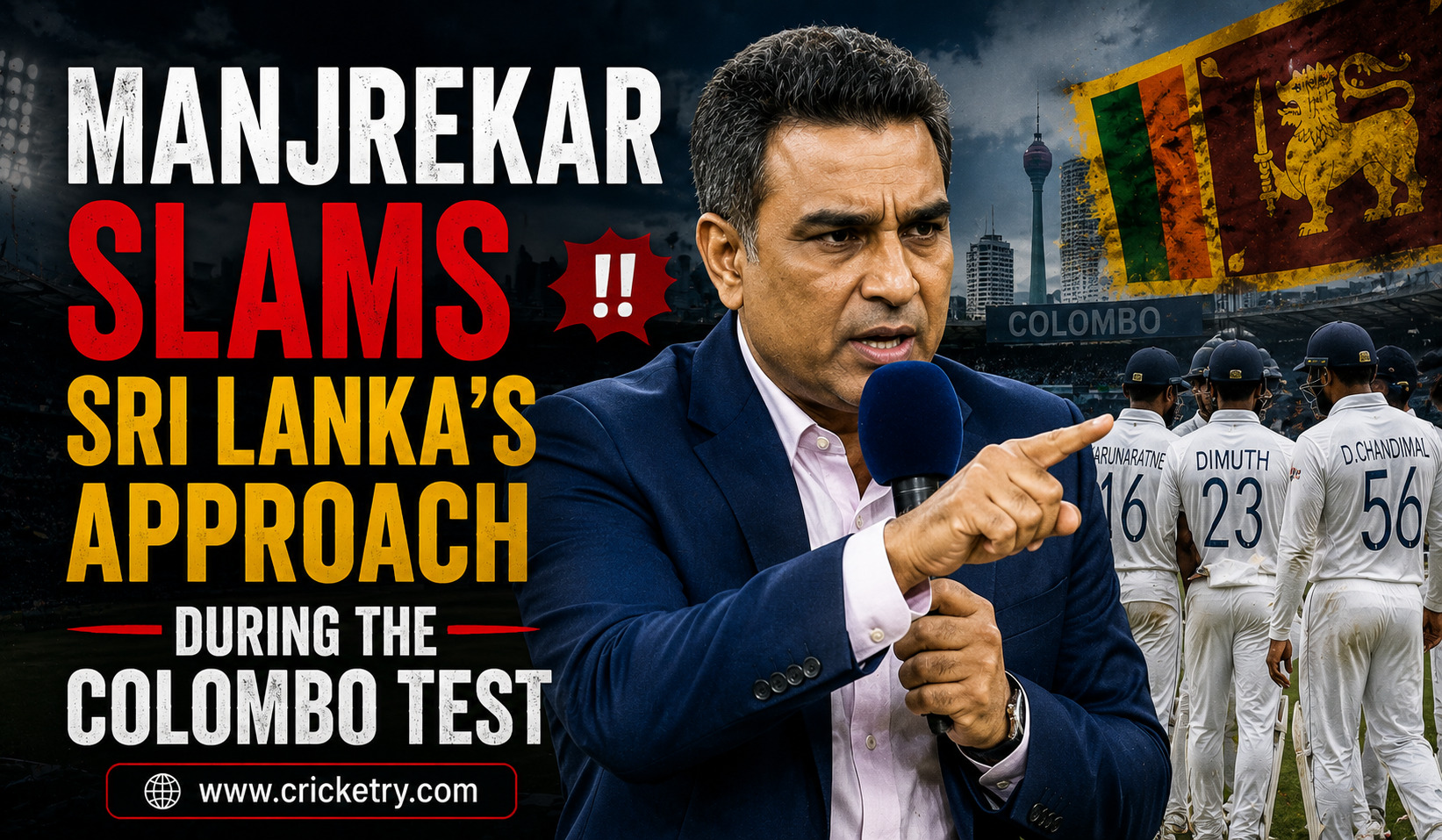

The second Test between India and Sri Lanka in Colombo has produced plenty of cricketing drama, but former India batter Sanjay Manjrekar has now questioned Sri Lanka’s approach during the closing stages of the second day. With deteriorating light becoming a major talking point, Manjrekar described the Sri Lankan players’ behaviour around the issue as “slightly unprofessional”, arguing that their concern over the conditions appeared to distract them from the cricket itself.
The controversy developed after India declared their first innings at 503 for nine. Sri Lanka then began their reply late in the day, but the hosts immediately found themselves under pressure. Prasidh Krishna dismissed Lahiru Udara, and Manav Suthar removed nightwatchman Prabath Jayasuriya with the final ball of the day. Sri Lanka ended the second day at 8 for 2, leaving India in a commanding position.
What caught Manjrekar’s attention was not simply the wickets. It was the repeated concern expressed by Sri Lankan batters about the fading light while play continued. According to reports, the umpires checked the light meter, while Sri Lankan players repeatedly indicated that conditions were becoming difficult.
Manjrekar believed that the discussion over bad light may have consumed too much of Sri Lanka’s attention. In his assessment, the players should have remained focused on facing the Indian bowlers, particularly because the conditions were still considered playable by the officials.
What Happened During the Final Overs of Day Two?
India had established a huge first-innings total of 503 for nine before declaring. Sri Lanka’s task was already difficult, but the timing of their innings made matters even more complicated.
The final session was affected by rain and changing weather. Once play resumed, Sri Lanka lost Udara to Krishna. The umpires then assessed the light as clouds gathered over the ground. However, they decided that play could continue.
Kamil Mishara and Jayasuriya were visibly concerned about the conditions. Their reactions became a central part of the discussion, especially when Jayasuriya was dismissed almost immediately afterwards.
Suthar produced the breakthrough with a delivery that trapped Jayasuriya lbw. The dismissal came on the final delivery of the third over of Sri Lanka’s innings, leaving the hosts in serious trouble at 8 for 2.
For Manjrekar, the sequence illustrated the danger of allowing a discussion about playing conditions to dominate the players’ concentration.
The key sequence from the end of Day Two was:
- India declared at 503 for nine.
- Sri Lanka began their first innings late in the day.
- Prasidh Krishna dismissed Lahiru Udara.
- Concerns about fading light emerged.
- Manav Suthar dismissed nightwatchman Prabath Jayasuriya.
- Sri Lanka finished the day at 8 for 2.
This sequence turned what might otherwise have been an ordinary closing session into one of the most discussed moments of the Test.
Why Did Manjrekar Call Sri Lanka’s Approach Unprofessional?
Manjrekar’s criticism was largely about concentration rather than Sri Lanka’s right to question the playing conditions.
The former India cricketer acknowledged that Sri Lanka may have had a legitimate concern about the light. However, he argued that repeatedly focusing on the umpires and the conditions could have distracted the batters from the immediate challenge of surviving against India’s bowlers.
His argument was straightforward: if the umpires had decided that the conditions were safe enough for play, the batters needed to focus completely on the next delivery.
That becomes particularly important at the end of a Test day. Batters are already under pressure because of tiredness, reduced visibility and the urgency to survive until stumps. Any additional distraction can increase the risk of losing concentration.
Jayasuriya’s dismissal immediately after the discussion about the light made the sequence look even worse for Sri Lanka.
Manjrekar praised Suthar’s delivery and suggested that the dismissal should be viewed as a result of good bowling rather than simply blamed on the difficult conditions.
Sri Lanka Had a Point About the Light
Manjrekar’s comments did not mean he believed Sri Lanka had no reason to question the conditions.
Bad light has always been a complicated issue in Test cricket. Unlike rain, which usually provides a clearer indication that play cannot continue, bad light involves judgment. The umpires use a light meter and assess whether the conditions are suitable for players.
The decision to continue is therefore not entirely controlled by either team.
Sri Lanka’s players were entitled to express their concerns, particularly if they believed visibility was becoming dangerous or difficult. The issue was how much attention they gave to the situation after the umpires had decided to continue.
That distinction is important. Manjrekar’s criticism was directed at the team’s response and concentration rather than simply their complaint about the weather.
He argued that once the decision had been made, Sri Lanka needed to accept it and focus on the ball.
How India Used the Situation to Their Advantage
India’s approach was very different. The visitors remained prepared to continue playing and made their position clear when the officials considered the conditions.
Manjrekar credited India for remaining on the field and putting pressure on the umpires to continue. He suggested that India’s status as one of the strongest teams in world cricket could also have influenced the atmosphere surrounding the decision.
India had every reason to want more cricket. They had already posted 503 and had an opportunity to expose Sri Lanka’s top order under difficult evening conditions.
The visitors ultimately benefited from that decision.
Within three overs, Sri Lanka had lost two wickets. Instead of reaching stumps comfortably, the hosts were suddenly 8 for 2 and facing the prospect of a long period of defensive cricket on the following day.
From India’s perspective, continuing the game was therefore tactically valuable.
Prabath Jayasuriya’s Dismissal Added to the Drama
Jayasuriya’s dismissal was particularly significant because he had been sent in as a nightwatchman.
A nightwatchman’s primary role is not to score quickly but to protect the recognised batters from facing difficult conditions at the end of the day. Once a team sends one in, the expectation is generally that the player will attempt to survive until stumps.
Jayasuriya lasted only seven balls before Suthar dismissed him for two.
The dismissal came immediately after the discussions over bad light, which made the moment even more frustrating for Sri Lanka.
Manjrekar praised Suthar for the quality of the delivery and rejected the idea that the wicket could simply be explained by the fading light. His point was that a batter must still be ready for every ball when the umpire has allowed play to continue.
That is perhaps the biggest lesson from the incident. Conditions can influence a game, but concentration remains the responsibility of the batter.
Sri Lanka’s Problems Were Bigger Than Bad Light
The debate over the light also risks hiding Sri Lanka’s larger problem in the Test.
The hosts had already allowed India to reach 503 for nine before declaring. Their task with the bat was therefore enormous even before the late-evening wickets.
Losing two wickets for eight runs made the situation significantly worse.
Sri Lanka’s challenge was now not simply to survive a few overs in fading light. They had to recover from an extremely difficult start against an Indian attack that had already gained momentum.
That is why Manjrekar’s criticism focused on the mental aspect of Sri Lanka’s approach. In Test cricket, teams can sometimes lose control of a session because of frustration, arguments or distractions.
Once that happens, wickets can follow quickly.
The Colombo situation provided a clear example of how a team’s mindset can change during a short period.
The Wider Context of Tension in the Colombo Test
The second Test has already been marked by several tense moments.
Earlier in the match, India’s Yashasvi Jaiswal and Sri Lanka fast bowler Asitha Fernando were involved in a heated confrontation following Jaiswal’s dismissal. The ICC subsequently fined both players 25 percent of their match fees and awarded them one demerit point each for breaching Article 2.12 of the Code of Conduct.
That incident created considerable discussion about player behaviour and sportsmanship.
The bad-light controversy added another layer of tension to the Test. Although the two incidents are separate, both contributed to a growing sense that the Colombo match has been more confrontational than a typical Test contest.
Sri Lanka’s Prabath Jayasuriya was also later reprimanded and received one demerit point for hitting boundary wedges with his bat after his dismissal, according to reports.
These episodes have ensured that attention has not been limited to batting averages, bowling figures and the scoreboard.
Manjrekar’s Main Concerns
Manjrekar’s comments can be understood through several broader themes surrounding Test cricket.
- Concentration: Players must remain focused even when conditions are frustrating.
- Respect for officials: Once umpires make a decision, players need to adapt rather than allow disagreement to dominate.
- Professionalism: Emotional reactions should not interfere with basic match discipline.
- Mental strength: Difficult conditions often test a team’s ability to stay composed.
These principles are particularly important in Test cricket because matches can turn rapidly. A team may spend hours building a position and then lose several wickets because of a brief lapse in concentration.
Sri Lanka experienced that problem at the end of Day Two.
Was Sri Lanka Wrong to Raise the Bad-Light Issue?
This is where the debate becomes more complicated.
It would be unfair to suggest that players should never question conditions. Player safety is important, and batters are entitled to raise concerns when visibility becomes difficult.
The responsibility ultimately belongs to the umpires, who decide whether play should continue.
The criticism from Manjrekar was therefore not necessarily that Sri Lanka complained. Instead, he believed their frustration appeared to affect their focus.
That distinction is crucial when evaluating the incident.
A professional team can disagree with an umpire’s decision while still remaining completely focused on the next delivery. Manjrekar felt Sri Lanka failed to maintain that balance.
India’s Advantage at the End of Day Two
The outcome was undeniably positive for India.
After declaring at 503 for nine, India needed early wickets to put Sri Lanka under maximum pressure. Krishna and Suthar delivered exactly that.
The visitors ended the day with two wickets in the bank and Sri Lanka’s top order under immediate pressure.
The situation can be summarised as follows:
| Match situation | India | Sri Lanka |
| First innings | 503/9 declared | Yet to respond fully |
| End of Day Two | Bowling attack in control | 8/2 |
| Key wickets | — | Lahiru Udara, Prabath Jayasuriya |
| Momentum | Strongly with India | Under pressure |
| Main controversy | — | Bad-light disagreement |
For India, the late wickets were almost as valuable as the runs scored earlier in the day.
What Can Sri Lanka Learn From the Incident?
The immediate lesson is about composure.
Sri Lanka cannot change the umpires’ decision or bring back the wickets lost before stumps. What the team can control is its response.
If the hosts want to compete against India, they need to focus on the fundamentals: leaving the right deliveries, defending patiently and avoiding unnecessary distractions.
The second lesson concerns communication.
Players can communicate concerns with officials without allowing those conversations to become the centre of attention. Senior players and the captain have an important role in ensuring that frustration does not spread through the team.
Finally, Sri Lanka needs to recognise that India will exploit every opportunity. The visitors demonstrated that by staying ready to bowl even when the light became an issue.
What Does This Mean for the Test?
The late drama has strengthened India’s position considerably.
Sri Lanka were already facing a huge deficit after India’s 503. Losing two wickets before stumps made the task even harder.
The hosts now need a major recovery with the bat. A strong partnership early in the next session could change the mood, but another cluster of wickets could put the Test firmly beyond their reach.
For India, the strategy is straightforward. The bowlers will look to maintain pressure, while the fielders will expect Sri Lanka’s batters to show patience.
The biggest battle may therefore be psychological as much as technical.
Conclusion
Sanjay Manjrekar’s criticism of Sri Lanka’s approach during the closing stages of Day Two has added another talking point to an already eventful Colombo Test.
His central argument was that while Sri Lanka may have had legitimate concerns about the fading light, their repeated focus on the issue appeared to distract them from the actual contest. Within a short period, they lost two wickets and finished the day at 8 for 2.
The controversy highlights one of the most difficult aspects of Test cricket: maintaining concentration when conditions are frustrating and decisions do not go exactly as a team wants.
India handled the situation differently. The visitors remained ready to continue and immediately capitalised on the opportunity when play went ahead.
Sri Lanka still has time to fight back, but the late collapse has placed them under significant pressure. Whether Manjrekar’s criticism proves to be a turning point will depend on how the hosts respond in the next phase of the match.
For now, the Colombo Test has shown once again that in international cricket, concentration can be just as important as skill. A few moments of distraction can change an entire session—and sometimes, an entire Test match.
FAQs
What did Sanjay Manjrekar say about Sri Lanka?
Manjrekar criticised Sri Lanka’s approach during the final stages of Day Two, describing it as “slightly unprofessional” because he felt the players’ concern about bad light distracted them from focusing on India’s bowling.
Why was bad light a controversy in the Colombo Test?
Sri Lankan batters repeatedly expressed concern about deteriorating light, while the umpires assessed the conditions and allowed play to continue. Sri Lanka subsequently lost two wickets in three overs.
What was Sri Lanka’s score at the end of Day Two?
Sri Lanka finished the second day at 8 for 2 after India declared their first innings at 503 for nine.
Who dismissed Prabath Jayasuriya?
India’s left-arm spinner Manav Suthar dismissed Jayasuriya lbw with the final delivery of the day.
Why was Prabath Jayasuriya batting as a nightwatchman?
Jayasuriya was sent in as a nightwatchman after Sri Lanka lost an early wicket, with the aim of protecting a recognised batter from facing the difficult final overs of the day.