
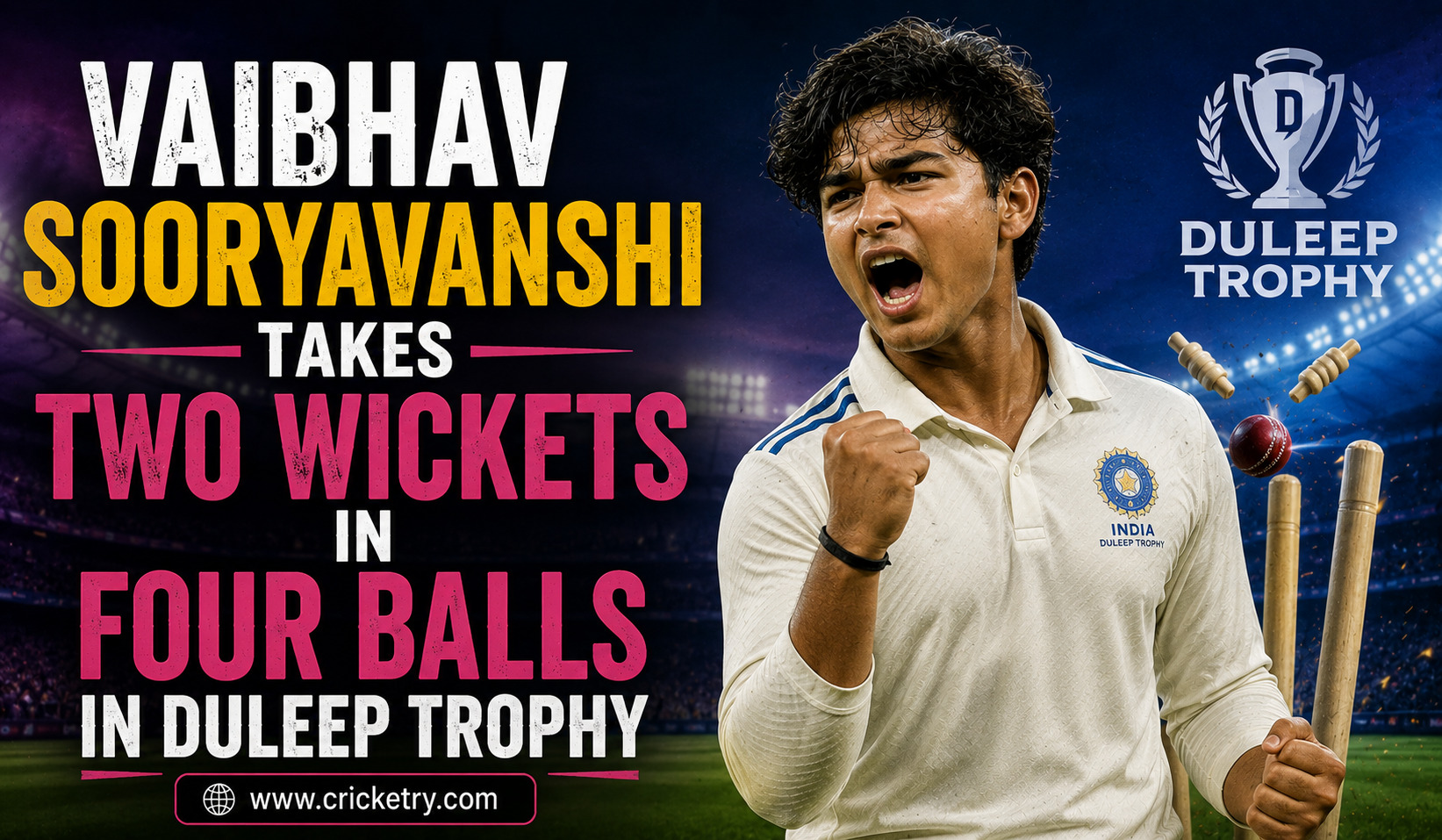
Vaibhav Sooryavanshi once again found a way to make headlines, but this time it was not his explosive batting that grabbed attention. The 15-year-old produced a surprising bowling performance for East Zone in the Duleep Trophy quarter-final against North East Zone, claiming two wickets in just four deliveries. His brief spell added another dimension to a young cricketer who has already attracted enormous attention for his fearless stroke play.
The match was played at the BCCI Centre of Excellence Ground 2 in Bengaluru, where Sooryavanshi entered the contest with expectations largely surrounding his batting. However, after being dismissed for only eight runs, he responded impressively with the ball. His two wickets came during North East Zone’s second innings and helped East Zone tighten their grip on the contest.
From Batting Disappointment to Bowling Impact
Sooryavanshi’s Duleep Trophy debut did not begin in the manner he would have wanted. The young left-handed batter managed only eight runs from six deliveries before losing his wicket. Given his reputation as one of India’s most exciting young batting talents, the early dismissal was understandably disappointing.
However, the teenager did not allow the batting failure to affect his contribution to the team. When captain Ishan Kishan handed him the ball during North East Zone’s second innings, Sooryavanshi made an immediate impact.
His response was particularly impressive because his bowling opportunity came in a match where East Zone were already firmly in control. Instead of simply completing an over, he showed enough discipline and accuracy to create pressure and collect two important wickets.
That ability to contribute after an unsuccessful outing with the bat is an encouraging sign. Cricket is often as much about responding to setbacks as it is about producing spectacular performances, and Sooryavanshi demonstrated that quality in Bengaluru.
How Sooryavanshi Took Two Wickets in Four Balls
The two wickets came in the same over and were separated by only four deliveries. His first breakthrough came against Kishan Lyngdoh.
Sooryavanshi bowled outside the off stump and encouraged Lyngdoh to come forward in an attempt to attack the delivery. The batter went for the shot but failed to control it properly, producing a leading edge towards the cover region. Substitute fielder Denish Das completed the catch, giving Sooryavanshi his first wicket.
The teenager did not have to wait long for another breakthrough. Three balls later, he bowled a good-length delivery around the off stump to Imliwati Lemtur. Lemtur attempted to defend from the crease but managed only a thin outside edge. Wicketkeeper Ishan Kishan reacted quickly and completed the catch.
Four deliveries had produced two wickets, turning Sooryavanshi’s short bowling appearance into one of the most talked-about moments of the match.
A Small Spell With a Big Impact
Sooryavanshi ultimately finished with figures of two wickets for 11 runs from three overs. While those numbers are modest compared with a conventional long bowling spell, the timing of his wickets made the contribution valuable.
North East Zone were attempting to resist East Zone’s dominance, and the two wickets helped accelerate their collapse. Reports from the match show that East Zone eventually completed a commanding innings-and-210-run victory, securing their place in the semi-finals.
The wider team performance was dominated by other players as well. Sudeep Kumar Gharami scored 146, while Shahbaz Ahmed produced an outstanding 167. Shahbaz also made a major contribution with the ball, taking four wickets in the match.
Sooryavanshi’s contribution therefore needs to be viewed as part of a strong overall East Zone performance rather than as the defining factor in the result. Nevertheless, his two-wicket burst added an intriguing storyline to the quarter-final.
The Numbers Behind the Performance
| Performance | Details |
| Team | East Zone |
| Opponent | North East Zone |
| Competition | Duleep Trophy 2026 |
| Batting | 8 runs |
| Bowling | 3 overs, 11 runs, 2 wickets |
| Wickets | Kishan Lyngdoh and Imliwati Lemtur |
| Key bowling moment | Two wickets in four balls |
| Match result | East Zone won by an innings and 210 runs |
The statistics highlight the unusual nature of Sooryavanshi’s performance. His batting contribution was minimal, but his bowling figures provided a useful correction to what could otherwise have been an unsuccessful individual outing.
Why the Bowling Performance Matters
Sooryavanshi is primarily recognised as an aggressive batter. His rapid rise through age-group cricket and domestic cricket has been built largely around his ability to score quickly and play attacking strokes. His occasional bowling has therefore received considerably less attention.
That makes the Duleep Trophy performance interesting. It does not suddenly establish him as a specialist bowler, nor should one short spell lead to exaggerated conclusions about his long-term role. Instead, it shows that he can potentially provide his team with another option when conditions or match situations require it.
For a young player still developing his red-ball game, having multiple ways to contribute can be valuable. Bowling can also give a player a different perspective on the game, particularly when understanding how batters react to different lengths and lines.
The more important takeaway is perhaps his attitude. After scoring only eight runs, he remained involved and responded when an opportunity arrived. That kind of resilience is particularly useful in a long-format competition.
Duleep Trophy Gives Sooryavanshi a Different Challenge
The Duleep Trophy represents a different challenge from the fast-paced limited-overs cricket in which Sooryavanshi has become famous. Red-ball cricket demands patience, concentration and an ability to adjust over longer periods.
For Sooryavanshi, the competition provides an opportunity to experience senior domestic cricket in a format where conditions and match situations can change significantly. His selection as East Zone’s vice-captain also places responsibility on him despite his age. Reports identified him as the 15-year-old vice-captain of the side led by Ishan Kishan.
His quarter-final performance showed both sides of that learning process. The eight-run dismissal with the bat highlighted the difficulty of adapting to a new format, while the two wickets demonstrated his ability to remain involved after a setback.
A Reminder That Young Players Need Time
The excitement surrounding Sooryavanshi has been enormous, but his Duleep Trophy outing also provides a reminder that young cricketers should be judged over time rather than through individual performances.
A player can score heavily in one match and struggle in another. Likewise, a batter can fail with the bat and still influence the game through fielding or bowling. Sooryavanshi’s latest performance illustrates exactly that point.
At 15, he is still at the beginning of his senior cricket journey. The Duleep Trophy is an important environment for learning how to handle experienced opponents, longer innings and pressure situations. Every match can offer lessons, even when the scoreboard does not produce spectacular batting numbers.
East Zone March Into the Semi-Finals
While Sooryavanshi’s two wickets became one of the memorable individual moments of the quarter-final, the bigger story was East Zone’s comprehensive victory. The side dominated both with the bat and ball and ended the contest with an innings-and-210-run win.
The victory means East Zone move forward in the competition, with their semi-final scheduled against Central Zone on August 30, according to reports.
For Sooryavanshi, the next stage represents another opportunity to develop his red-ball game. Whether he gets another chance to bowl or is required to make a major contribution with the bat, the experience itself could prove valuable.
What This Means for Sooryavanshi’s Development
The biggest significance of the performance is not the two wickets alone. It is the evidence that Sooryavanshi is capable of adapting when his primary skill does not produce the desired result.
His batting dismissal could easily have resulted in a quiet day for the youngster. Instead, he stayed involved, accepted the opportunity with the ball and delivered two breakthroughs. That response is perhaps more encouraging than the raw figures themselves.
There is still a long road ahead. Developing consistency in red-ball cricket requires time, and one three-over spell cannot establish a player’s bowling credentials. But performances like this can increase confidence and give coaches another potential tactical option.
For fans, meanwhile, the moment provides another reason to watch Sooryavanshi’s progress. The teenager has already established himself as an aggressive batter, and his latest Duleep Trophy outing showed that he can occasionally surprise opponents with the ball too.
Conclusion
Vaibhav Sooryavanshi’s two wickets in four balls against North East Zone added an unexpected twist to his Duleep Trophy quarter-final. After scoring only eight runs, the teenage East Zone vice-captain responded with a short but effective spell, dismissing Kishan Lyngdoh and Imliwati Lemtur in the same over.
His final figures of two wickets for 11 runs from three overs were only a small part of East Zone’s dominant innings-and-210-run victory, but they gave the young cricketer another memorable moment in his developing career.
The performance should not be interpreted as proof that Sooryavanshi is suddenly an all-rounder. Instead, it demonstrates his willingness to contribute in different ways and, importantly, to respond positively after disappointment. As he continues gaining experience in domestic cricket, that adaptability could become an important part of his development.
Frequently Asked Questions
1. How many wickets did Vaibhav Sooryavanshi take in the Duleep Trophy match?
Vaibhav Sooryavanshi took two wickets for 11 runs from three overs against North East Zone.
2. How quickly did Sooryavanshi take his two wickets?
He dismissed two batters within four deliveries in the same over.
3. Who were Sooryavanshi’s two victims?
His wickets were Kishan Lyngdoh and Imliwati Lemtur.
4. How many runs did Sooryavanshi score?
He scored eight runs from six balls during East Zone’s innings.
5. Did East Zone win the match?
Yes. East Zone defeated North East Zone by an innings and 210 runs and advanced to the semi-finals.
About the Author