
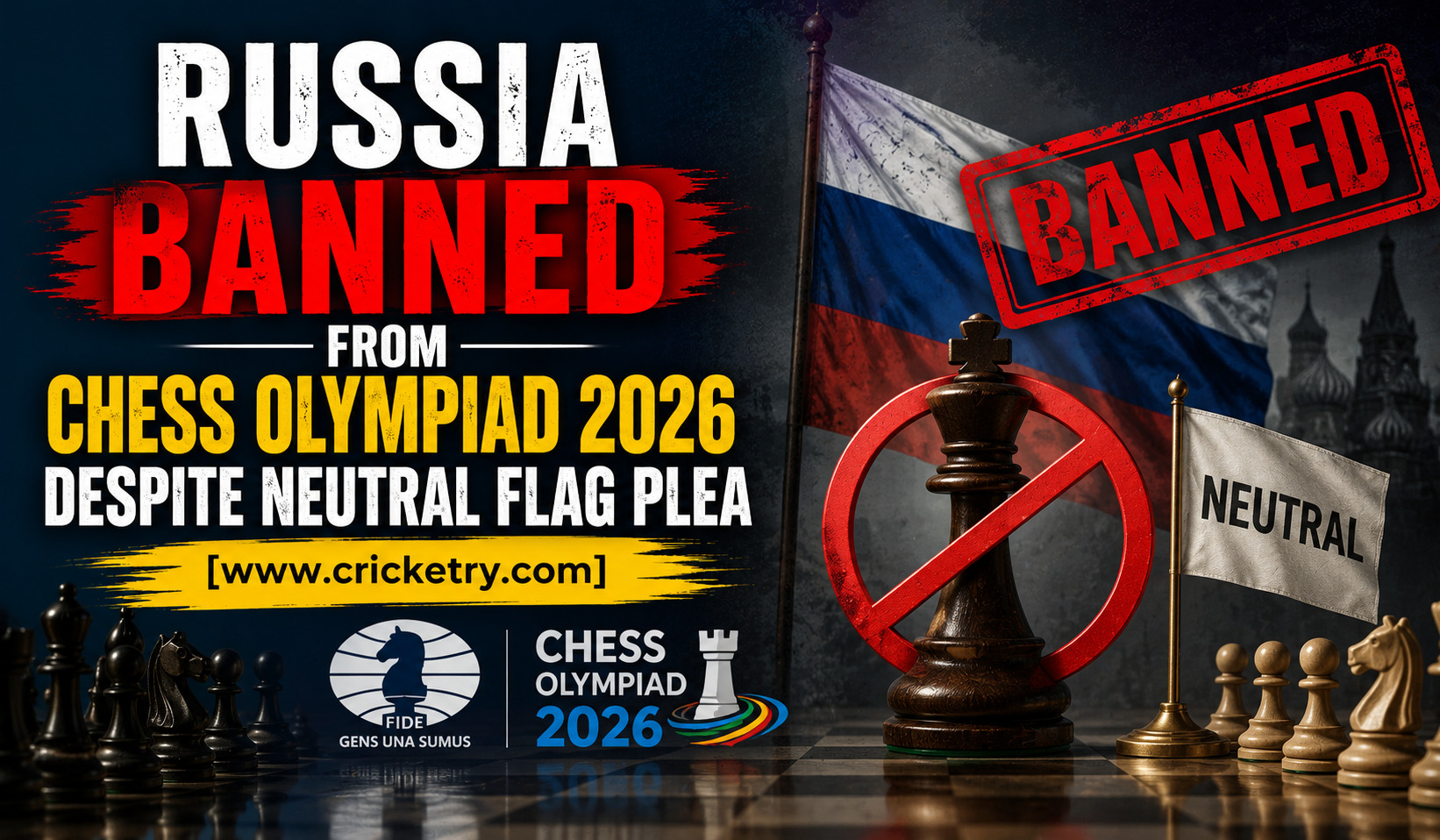

Russia will miss the 2026 Chess Olympiad in Samarkand after the International Chess Federation (FIDE) rejected a last-minute attempt to allow Russian national teams to participate under a neutral flag. The decision means Russia will be absent from the prestigious team competition for a third consecutive Olympiad, extending a dispute that has combined chess, international sport and the wider political fallout from the war in Ukraine.
The decision is notable because the situation surrounding Russian chess had appeared to be moving in a different direction. In late 2025, FIDE’s General Assembly voted to restore the participation rights of Russian and Belarusian teams in official FIDE tournaments. That development created expectations that Russian national teams could return to major team competitions in 2026.
However, the FIDE Council ultimately voted against allowing Russia’s men’s and women’s teams to compete at the 2026 Chess Olympiad. A proposal that would have allowed the teams to enter under the FIDE banner rather than the Russian flag failed to secure approval.
The result has left Russian chess officials disappointed and reopened a debate about whether sporting bodies should separate individual athletes from national teams when political sanctions remain in place.
What Happened to Russia’s Neutral Flag Request?
Russia’s national teams had hoped that a neutral arrangement could provide a compromise. Instead of competing under the Russian flag and national symbols, the teams could have entered under a FIDE designation.
That proposal was intended to address concerns surrounding national representation while allowing Russian players to return to one of the biggest events on the international chess calendar.
The FIDE Council did not accept the proposal for the 2026 Olympiad. As a result, Russia’s open and women’s teams will not take part in the tournament in Samarkand.
The decision is particularly striking because Russian players have continued to compete individually in international chess under neutral arrangements. The distinction between individual participation and national-team participation has been at the heart of FIDE’s policy since restrictions were introduced following the 2022 invasion of Ukraine.
For Russian chess, the outcome therefore represents a mixed picture. Individual players can continue to appear at many international events, but the Russian national teams remain excluded from the Chess Olympiad.
Why Is Russia Still Restricted From the Chess Olympiad?
The roots of the dispute go back to 2022, when FIDE suspended the Russian and Belarusian national teams from official team competitions following the Russian invasion of Ukraine.
The move followed recommendations from the International Olympic Committee and was part of a wider international sporting response. FIDE also stopped Russia and Belarus from hosting official events under the existing arrangements.
The Chess Olympiad was directly affected. Russia, one of the most successful countries in chess history, was unable to compete as a national team at the 2022 Olympiad in Chennai and the 2024 Olympiad in Budapest.
That made the 2026 event particularly important. After years of restrictions, Russian officials believed the changing FIDE position could finally create a route back into team competition.
Instead, the Council’s latest decision means Russia will miss another Olympiad.
The sequence can be broadly understood through these developments:
- Russia and Belarus were removed from official team competitions after the 2022 invasion of Ukraine.
- Individual players continued to compete under FIDE or other neutral arrangements.
- FIDE’s General Assembly voted in 2025 to restore team participation rights.
- The FIDE Council subsequently rejected Russia’s request to compete at the 2026 Olympiad.
This complicated history explains why the latest decision has generated such strong reactions.
The 2025 FIDE Vote Created Expectations
One of the most important parts of the story is the decision made by FIDE’s General Assembly in December 2025.
Delegates voted to remit teams from Russia and Belarus to official FIDE tournaments. The decision also allowed greater use of national symbols in youth and junior competitions, while other restrictions were adjusted in line with Olympic recommendations.
That vote appeared to mark a significant shift from the policy introduced in 2022.
Russian officials and supporters of reinstatement argued that the decision should open the door for national teams to return to major competitions. But the subsequent process showed that the General Assembly decision did not automatically settle every question surrounding eligibility for specific events.
The 2026 Olympiad became a major test of that policy.
The FIDE Council’s decision effectively prevented the Russian teams from using the new pathway to return to the event in Samarkand.
Why Does the Neutral Flag Matter?
The neutral flag proposal is important because it represents an attempt to separate players from national political representation.
Under a neutral arrangement, Russian players could theoretically compete without displaying the Russian flag, using the FIDE name or another approved neutral designation instead.
This approach has already been used in various forms across international sport. Chess itself has allowed individual Russian and Belarusian players to compete under the FIDE banner rather than their national federation’s identity.
The argument in favour of neutrality is that individual players should not necessarily be punished for geopolitical decisions made by governments. Many athletes have little or no influence over state policy.
However, national-team competitions create a different problem.
The Chess Olympiad is built around teams representing federations and countries. Even without a national flag, a Russian team would still be understood as a Russian national team by many spectators.
That is one reason the issue has remained controversial.
Individual Players and National Teams Face Different Rules
The latest decision highlights a distinction that can sometimes be overlooked.
A Russian grandmaster competing individually under the FIDE flag is not the same as Russia entering a national team in the Chess Olympiad.
Individual tournaments can often accommodate neutral participation relatively easily. A player can compete without a national flag or anthem while still participating as an individual.
Team competitions are more complicated because the identity of the federation becomes part of the event itself.
FIDE’s current position has allowed Russian adult players to participate individually under the FIDE banner, while national-team participation has remained subject to additional decisions. Reuters reported in June that FIDE’s rules allowed Russian adults to continue competing individually under the FIDE flag, while the status of team events remained subject to further decisions.
That distinction explains why a Russian player can appear at a major chess tournament while the Russian national team remains absent from the Olympiad.
What Does Russia’s Absence Mean for the Chess Olympiad?
Russia has traditionally been one of the strongest forces in international chess. Its history includes world champions, elite grandmasters and generations of successful Olympiad teams.
The country’s absence therefore changes the competitive landscape.
The Chess Olympiad is not simply another tournament. It is one of the largest team events in the sport, bringing together leading players from around the world.
Without Russia’s men’s and women’s teams, other chess nations have a greater opportunity to compete for medals without facing one of the deepest national programmes in the sport.
For younger teams, the absence can also create opportunities. Countries that might previously have struggled to reach the podium can now enter the tournament with greater expectations.
At the same time, some fans will argue that the event loses something by excluding one of chess’s most historically important countries.
That tension is at the centre of the debate.
Russia’s Long History at the Olympiad
Russia’s importance to the Chess Olympiad cannot be overstated.
The Soviet Union dominated international team chess for decades before the breakup of the USSR. Russia inherited much of that tradition and remained one of the leading powers after independence.
The country has produced numerous world-class players, including Garry Kasparov, Anatoly Karpov, Vladimir Kramnik and many other grandmasters.
Its national teams have regularly been among the favourites at major international competitions.
That history makes three consecutive Olympiad absences particularly significant.
The 2026 Samarkand tournament will therefore be another major event without one of the sport’s traditional superpowers.
The Political Debate Around Chess
The dispute is part of a much larger question facing international sport.
Should athletes and teams from a country be allowed to compete when their government is involved in an ongoing international conflict?
Supporters of restrictions argue that national teams represent countries rather than merely individual athletes. From that perspective, allowing a Russian national team to return could be interpreted as normalising the country’s sporting representation.
Those who favour reinstatement argue that chess players should not be permanently excluded because of political events outside their control.
The neutral-flag proposal attempts to find a middle ground, but the latest decision demonstrates how difficult that compromise can be.
Even if players compete without Russian symbols, the team would still carry an association with the Russian Chess Federation.
How FIDE’s Position Has Evolved
FIDE’s policy has not remained completely static since 2022.
Initially, the organisation adopted strong restrictions on Russian and Belarusian national teams while allowing individual players to participate under strict neutral conditions.
Over time, international sporting policies changed in some areas, particularly for youth competitors. FIDE’s General Assembly later voted for broader restoration of participation rights.
Yet the 2026 Olympiad decision demonstrates that the return process remains incomplete.
The evolution of the policy can be summarised as follows:
| Period | FIDE position |
| 2022 | Russian and Belarusian national teams suspended from official team competitions |
| 2022–2025 | Individual participation continued under neutral arrangements |
| December 2025 | General Assembly voted to restore teams to official FIDE tournaments |
| 2026 Olympiad | FIDE Council rejected Russia’s participation |
| 2026 | Russian national teams remain absent from the Olympiad |
This complicated timeline is why the current decision has caused confusion among fans and players.
What Could Happen Next?
The immediate consequence is clear: Russia’s men’s and women’s teams will not play in the 2026 Chess Olympiad in Samarkand.
The larger question is whether the issue will be revisited before future team competitions.
The latest decision does not necessarily settle the broader debate over Russian participation permanently. FIDE’s policies can change through future votes, Council decisions and developments in international sporting regulations.
Russia could therefore continue to push for national-team reinstatement, particularly after the General Assembly’s 2025 decision.
At the same time, organisations and federations opposed to reinstatement are likely to continue arguing that the current circumstances do not justify a return.
The disagreement is unlikely to disappear quickly.
Why the Decision Is Important for Russian Players
For Russian grandmasters, the exclusion of the national team creates a difficult situation.
An elite player may still compete individually at major international tournaments, maintain a world ranking and participate in top-level events. But the experience of representing Russia alongside teammates at an Olympiad remains unavailable.
For many players, the Olympiad is one of the most meaningful events in a chess career because it combines individual performance with national-team competition.
The absence of Russia means that an entire generation of players is losing the opportunity to compete under their national banner at one of the sport’s biggest events.
That is particularly significant for younger grandmasters who have not yet experienced an Olympiad representing Russia.
What the Samarkand Olympiad Represents
The 2026 Chess Olympiad in Samarkand will be watched closely not only for the games but also for what it says about the future of international chess.
Uzbekistan has become an increasingly important centre for chess, and hosting the Olympiad represents another major step in the country’s development as a chess destination.
The absence of Russia, however, will remain one of the major stories surrounding the tournament.
The event will show how competitive the Olympiad can be without one of its traditional giants. It will also demonstrate whether the new generation of chess powers can take advantage of Russia’s continued absence.
Conclusion
Russia’s hopes of returning to the 2026 Chess Olympiad under a neutral flag have been rejected, meaning the country’s national teams will miss the event in Samarkand for a third consecutive edition.
The decision comes despite a major policy shift within FIDE at the end of 2025, when the General Assembly voted to restore Russian and Belarusian teams to official FIDE competitions.
However, the subsequent FIDE Council decision shows that the question of national-team participation remains unresolved in practice.
For Russia, the outcome is another setback for its efforts to regain full status in international chess. For FIDE, it highlights the continuing difficulty of balancing sporting neutrality, individual player rights and the political realities surrounding national representation.
The neutral-flag proposal offered a possible compromise, but it was not enough to secure Russia a place in Samarkand.
Russian players will continue to compete individually under neutral arrangements, but the country’s national teams will once again be missing when the world’s leading chess nations gather for the Olympiad.
The next major question will be whether this remains the status quo or whether future FIDE decisions finally create a lasting route for Russia’s return to international team chess.
FAQs
Why is Russia banned from the 2026 Chess Olympiad?
Russia’s men’s and women’s national teams will not participate after the FIDE Council rejected their participation in the 2026 Olympiad in Samarkand.
Did Russia ask to compete under a neutral flag?
Yes. Russia made a last-minute attempt to have its teams participate under a neutral FIDE designation rather than competing under Russian national symbols. The proposal was rejected.
Is this Russia’s first missed Chess Olympiad?
No. Russia has already missed the 2022 and 2024 Olympiads because of restrictions introduced following the 2022 invasion of Ukraine. The 2026 event will therefore be the third consecutive Olympiad without Russian national teams.
Can Russian chess players still compete internationally?
Yes. Russian adult players have continued to participate individually under the FIDE flag in international events, subject to the applicable rules.
Why is the neutral flag issue controversial?
Supporters believe neutral participation can allow athletes to compete without representing national political positions. Opponents argue that a national team remains a form of state representation even without a flag or anthem.